
Today January 31, 2026, 03:10 PM
Today January 31, 2026, 03:10 PM
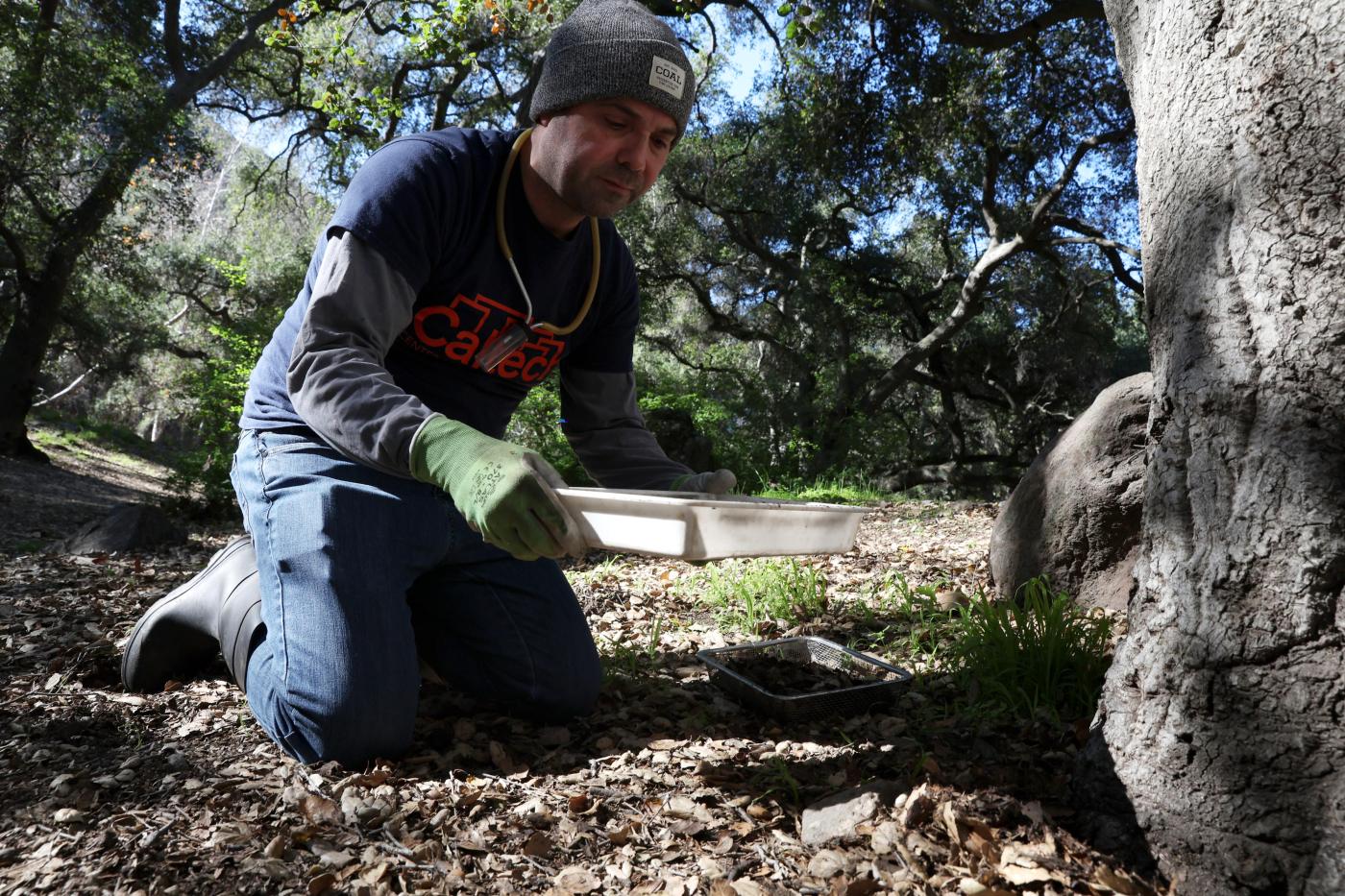
Joe Parker, a Caltech entomologist who has studied indigenous forest ants in key canyons above Pasadena and Altadena for eight years, felt his heart sink as he watched by live video the Eaton fire burn through the canyon where his documented ant colonies live.
Thinking they were all gone, along with nearly a decade of research, he and his team of graduate students a few months after the Jan. 7, 2025, fire got permission to visit Millard Canyon. He was surprised to find 13 of 15 ant colonies his team had documented pre-fire had survived.
These ants, the velvety tree ant (Liometopum occidentale) that survived in Millard Canyon were holed up inside the trunks of 13 coast live oak trees, a fire-resistant tree species dominant in the canyons of Southern California.
“We feared the worst as we watched on the video app as the fire engulfed the canyon. It was amazing to see how the ants were still there, protected inside the coast live oaks trees in which they nest by excavating the internal heartwood of these trees and building a complex nest structure inside,” Parker said.
“Of the 15 trees we had recorded as containing ant colonies, 13 were still standing with the ants surviving inside. It was very uplifting to realize the ants’ strategy — to nest inside fire-adapted oaks, enabling them to withstand the fire,” Parker added.
The amazing find rattled his brain with questions: How did these tiny ants know they could find shelter from a fierce fire by living inside the live oaks? And isn’t this tantamount to finding a “house” that is fire-proof, something that some 6,000 homeowners in Altadena who lost everything and are attempting to rebuild are also learning, an adaptation known as home hardening.
“These (ant) colonies are likely very long lived. So, sooner or later, when a blaze will come to your doorstep, it’s critical you have a fire-proof home,” he said.
Parker wondered if the ants felt the heat and burrowed into the tree to escape the flames? Most likely, he said these ants make nests inside these trees that last for years; they don’t move out of their protective homes. But the questions scream out for more study.
“Maybe the ants moved farther up into the tree? What was the temperature inside the tree? I don’t really know. Maybe they over compensate by tunneling up inside the tree,” he said.
Surprising observations that his team had not fully studied nonetheless underscored Parker’s conclusions on how nature survives fire through years of built-up resistance. He also spotted new flowers and other fire-following plants popping up in the canyons, whose seeds burst open from the heat of the fire. And through more close study, he found the ants were not just surviving, but thriving.
Most biologists studying post-fire canyons have seen coast live oak trees singed but not destroyed, while other trees are wiped out.
Not many trees were lost by the fire inside Eaton Canyon Natural Area Park, located on the border of Pasadena and Altadena. “About 85% to 90% of the oak and sycamore trees survived,” said Cristhian Mace, natural areas biologist with LA County Parks and Recreation.
Ants hiding out in bay laurel trees in Millard Canyon were burned up in the fire; even the trees insides burned, Parker said. They do not have thick trunks useful for burrowing.
“So if you were a queen ant and you were founding a new colony, you would probably want to hedge your bets and go into a coastal live oak,” he said.
Aside from comparisons to making homes and communities more fire resistant, the velvety fire ants are also considered proverbial canaries in the coal mine. Since they survived, it’s a signal that the other plants and animals in these fire-ravaged canyons are also doing well a year after the Eaton fire.
“Yes. It is an indicator of the functionality of the ecosystem,” Parker said. “If this ant is doing well, the community at large is likely doing well. It tells you the whole ecosystem is able to buffer the impact of the fire.”
Why are the life of ants important?
Because they provide benefits to the canyons, such as soil remediation. They also protect the life of aphids from parasitic wasps. Aphids are needed to keep the system in balance. “The ants are affecting the rates of plant growth in that ecosystem in an appropriate way,” he said.
Velvety tree ants live in the canyons and set up colonies often a meter high up the bark of a tall oak tree. These are not house ants that follow trails of water or duck into a wall to escape heat. Those are invasive ants that were imported from South America, he said.
No, the velvety tree ant exist in huge colonies of several million workers per colony. The foothills and canyons of the San Gabriel Mountains are dominated by this one ant species, which interact with thousands of other species in the forest ecosystem.
“They are a keystone species here that is plugged into the local ecology,” he said.
Parker, who grew up in the United Kingdom, loved to look at beetles as a child (not The Beatles, as in the rock group).
He ended up studying Rove beetles, which have a symbiotic, even parasitic relationship with tree ants. These beetles infiltrate and exploit the ants in the colonies. As stealth intruders, the beetles groom the ant bodies by smearing their own body with ant chemicals so they are recognized as a host ant, he said.
In Big Dalton Canyon above Glendora, Parker knelt eye level with a large coast live oak. He brushed away the leaf litter at the base, exposing swarms of velvety tree ants. Along with Caltech graduate students in biology, Esther Okamoto and Joani Viliunas, they were capturing ants along with Rove beetles to bring back to the lab for further study.
“This is the most important animal in the forest that nobody has ever seen,” he said.
The two species — working symbiotically — could be a foundation to the entire forest ecosystem.
Certainly, more study of the velvety tree ant, especially before and after a major fire, could shed new light on survival techniques for both animals and humans.
Parker, who may be biased, agrees.
“Insects comprise the bulk of animal diversity and are integral to the health of the planet. It is therefore crucial that we understand the roles they play in natural environments, no matter how small and easily overlooked they may be,” Parker said.
An addition to his years of research may be studying how these forest ants escape destruction from a wildfire. Is it instinctual, a result of evolutionary learning? Or just a fight or flight reaction?
“You are talking about an organism that is both integral to the ecology of this part of the world, and find themselves with a strategy to cope with arguably the most extreme form of an event this ecosystem has to offer, which is fire. This ant has some amazing solutions to cope with that,” Parker said.


