Today March 5, 2026, 02:09 AM
Today March 5, 2026, 02:09 AM
The Los Angeles City Council on Wednesday unanimously approved the first seven motions in Councilmember Adrin Nazarian’s “Keep Hollywood Home” initiative, a package of nine proposals aimed at streamlining the city’s film-permitting process and helping retain production jobs in Los Angeles.
The measures direct several city departments to develop new policies and reports intended to simplify film permitting, improve coordination between regional agencies, and support the development of film production infrastructure, as city leaders face growing concerns that filming is increasingly shifting to other states and countries offering financial incentives and faster permitting.
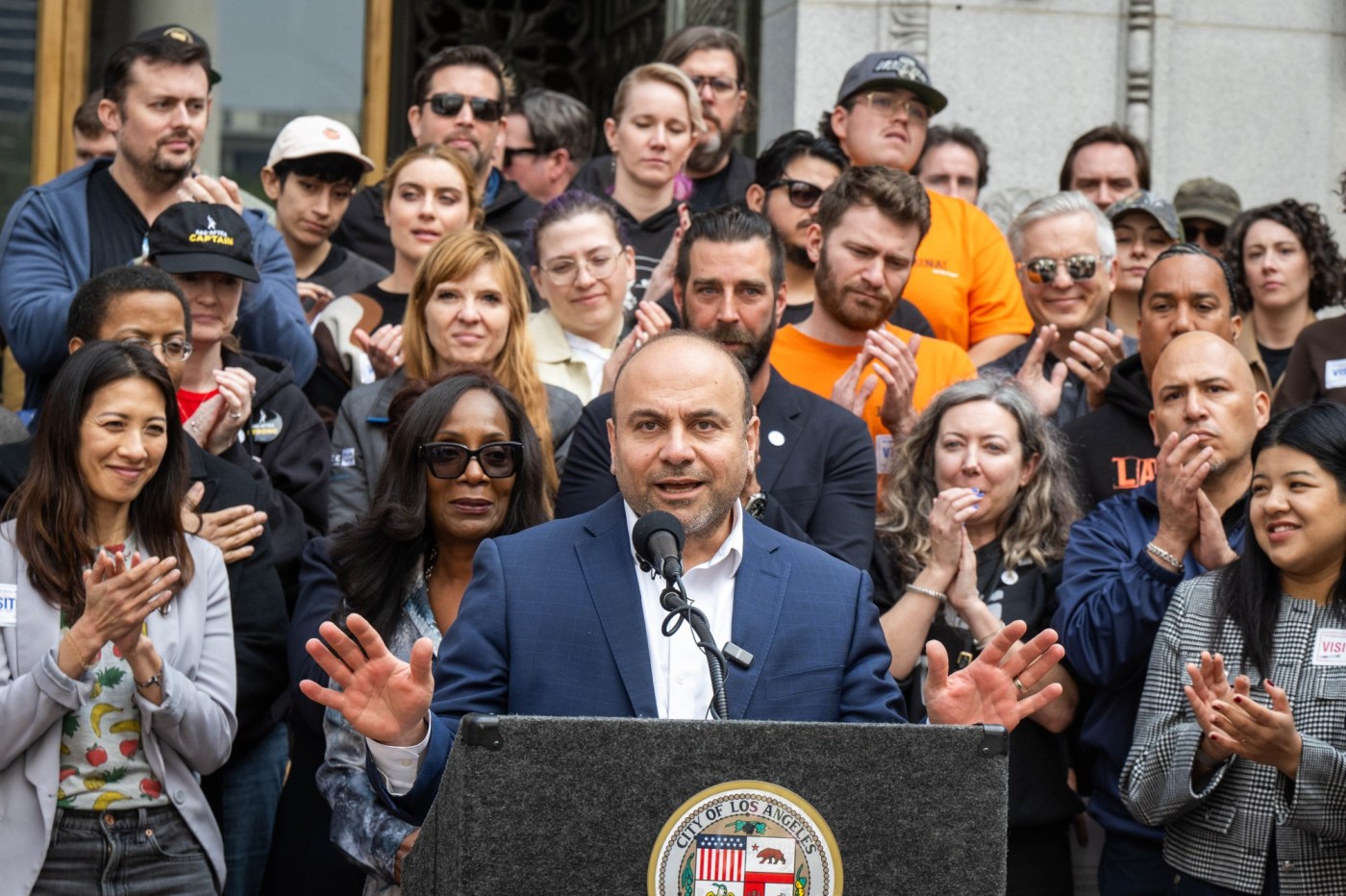
Speaking before the vote, Nazarian said Los Angeles can no longer rely on its historical dominance in the entertainment industry as other jurisdictions aggressively compete for productions.
“For more than a century, this city has been the global capital of storytelling, but history alone will not protect us,” Nazarian said. “Production is mobile, capital is mobile, talent is mobile, and jurisdictions across this country and around the world are competing aggressively for what we once assumed would always stay here.”
Council President Marqueece Harris-Dawson said the effort is about protecting union jobs in the entertainment industry that support working families across the region.
“We need jobs in Southern California where a mother or a father can go to work, work hard all day, and make enough to have the basic needs for their families met without question,” Harris-Dawson said. “Union entertainment industry jobs do that, and we will protect them with everything that we have in the city of Los Angeles.”
The seven motions represent the first phase of Nazarian’s broader “Keep Hollywood Home” initiative, which seeks to update the city’s permitting system while strengthening the local production ecosystem.
Among the actions approved Wednesday, the council directed city departments to develop regional agreements with neighboring jurisdictions to better coordinate film permitting and workforce development efforts. Other measures call for a unified citywide filming conditions framework, a fast-track certification program for soundstages and an independent audit of the city’s film-permitting system.
Earlier versions of the proposal would have immediately rescinded long-standing neighborhood filming “special conditions,” which can require additional notifications or community surveys before productions take place. But council members scaled back that provision in committee last month, directing city departments to develop a unified framework and report back before making those changes.
During the council meeting, Councilmember Ysabel Jurado, whose district includes downtown Los Angeles, briefly proposed removing language that would exempt downtown Los Angeles from certain residential notification surveys for filming.
Jurado said businesses in the area sometimes receive little advance notice when productions close streets or restrict parking, which can hurt sales during busy periods.
She later withdrew the amendment, saying she planned to continue working with Nazarian’s office to address concerns from downtown businesses.
“We’re not scared of things that we need to take on for the city, but we look forward to working with Councilmember Nazarian to make sure that we carefully consider downtown as we promote the film and TV,” Jurado said.
Nazarian’s initiative comes as industry workers and unions warn that a prolonged slowdown in film and television production has strained livelihoods across the region.
Following the vote, dozens of film and television workers gathered in the City Hall forecourt for a news conference celebrating the council’s action.
Several industry workers said the reforms could help stabilize a sector that has faced significant contraction in recent years.
Jim Revis, a business representative for IATSE Local 871, which represents production coordinators, accountants and other film crew members, said the slowdown in local production has directly affected workers’ ability to maintain health coverage and steady employment.
“The first and foremost is health care coverage because our health and pension benefits are paid through working—that’s been the biggest impact,” he said. “The California film incentives just recently increased. It is now very competitive with other states. We’ve already seen a lot of projects getting rewarded with that incentive, so things are starting to ramp up.”
Cale Thomas of the advocacy group Stay in L.A., said the council’s decision marks the beginning of a broader effort to keep production in the region.
“This is a starting point,” Thomas said. “This is the beginning of a conversation, a bigger conversation. But I think it’s really, really important that the city actually has the conversation, and this is the moment in which we all can agree that we need to make fundamental changes.”
FilmLA CEO Denise Gutches reiterated the organization’s support for the initiative following the vote.
“Today’s vote makes clear that there is an unprecedented level of interest from the greater L.A. community in doing things differently, and we look forward to working closely with our city partners to make on-location filming as affordable, accessible, and straightforward as possible,” Gutches said.
Among the actions approved Wednesday:
• Direct city officials to develop regional agreements with neighboring jurisdictions to coordinate film-permitting rules.
• Report on a unified citywide filming conditions framework.
• Develop a certification and fast-track permitting program for soundstage development.
• Requiring departments to report on implementation of Mayor Karen Bass’ Executive Directive 11 on film permitting.
• Directing tourism officials to study the creation of a citywide film-location fan tour and a “Made in L.A.” branding initiative highlighting the city’s cinematic history.
• Requesting the City Controller conduct an audit of the film-permitting ecosystem, including departmental staffing and FilmLA’s contract performance.
• Asking the City Attorney to draft an ordinance establishing a free “microshoot” permit for very small productions.
Two additional proposals in the broader package have not yet advanced to the full council.
One would reduce or waive fees for productions using certain city-owned parking lots and staging areas, while another addresses staffing requirements for safety monitors during filming. Nazarian’s office said those measures remain under discussion as the city evaluates potential fiscal impacts and operational details.
Nazarian said the reforms approved Wednesday represent the first step in a broader effort to strengthen Los Angeles’ production economy.
“We are not done,” he said. “Phase 2 is already underway. Today was about immediate relief. Tomorrow is about long-term competitiveness.”
Additional proposals under a second phase of the initiative are expected to focus on production incentives, support for local vendors and strengthening the region’s workforce pipeline. Ideas proposed by Nazarian’s office include a public-private seed fund for low-budget productions, local vendor incentive programs and expanded accountability requirements for city film contracts.