Today January 23, 2026, 02:55 AM
Today January 23, 2026, 02:55 AM
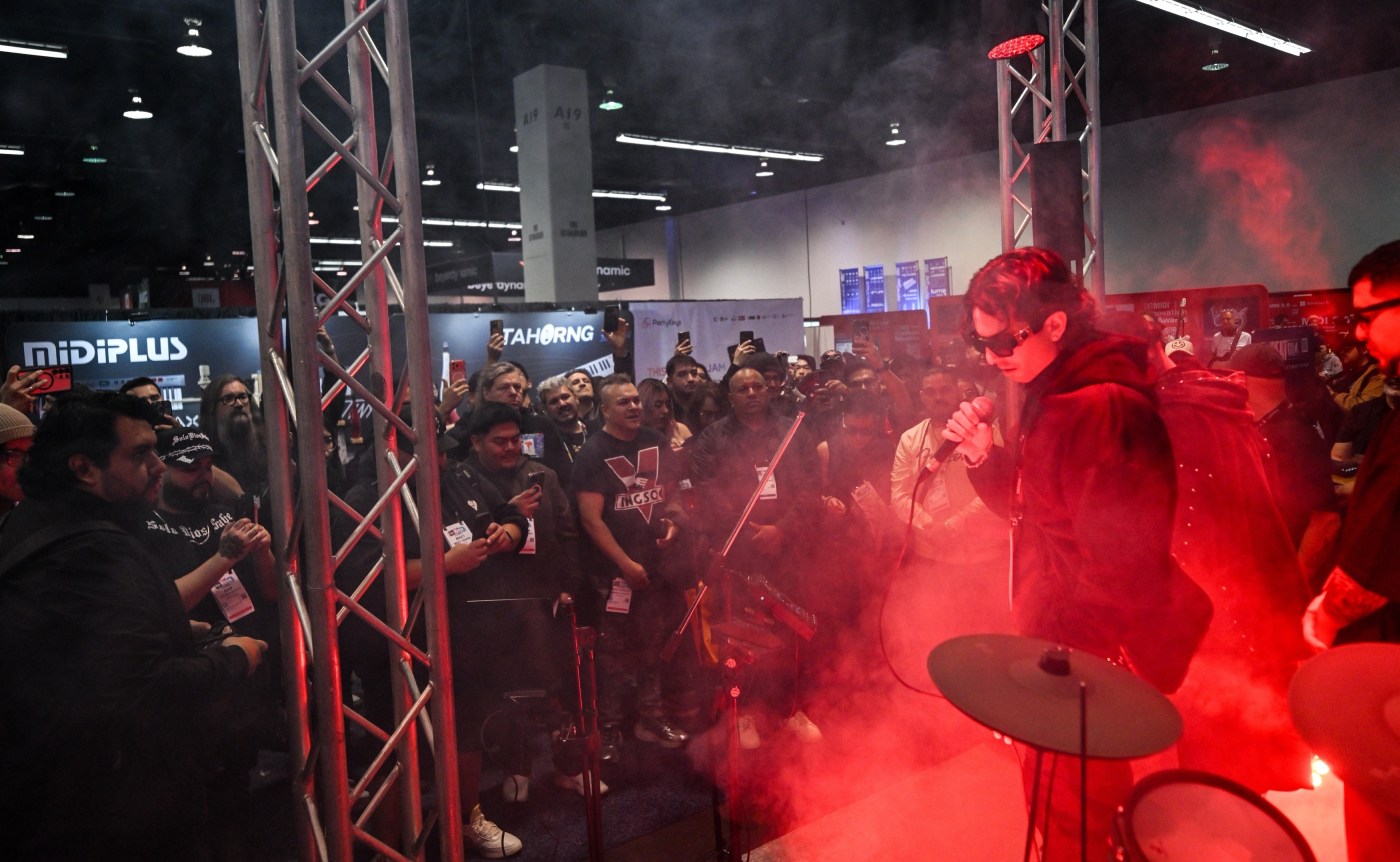
Percy Bady stood amid a throng of musicians and onlookers at a booth at the NAMM Show at the Anaheim Convention Center on Thursday, Jan. 22.
As an R&B and gospel songwriter-producer, he’s responsible for cowriting such well-known tunes as R. Kelly’s “I Believe I Can Fly,” Yolanda Adams’ “Still I Rise,” the modern gospel standard “There Is No Way,” and BeBe and CeCe Winans’ “Hold Up the Light,” which featured Whitney Houston.
When the crowd around a booth spills into the walkways at NAMM, it’s a sure sign that someone notable is there, and plenty of people had stopped to listen to Bady and a band that featured some of his longtime collaborators, including his youngest brother, Ray Bady.
“I’ve been coming here 25 years,” Bady said at the end of his short set on Thursday. “I’m looking at everything that helps me do what I do as a songwriter and producer.
“But the thing I enjoy most is getting together with the community,” he said of the friends and fellow musicians that he finds time to catch up with while at the NAMM Show.
Ray Bady, who is 10 years younger, recalled how his brother’s music had coaxed him out of the pulpit – he’s a senior pastor at a large Chicago church – to back him on drums over the years.
“In 1986, I see him on ‘The Arsenio Hall Show’ with Whitney, playing ‘Hold Up the Light,’” Ray Bady said. “They tried to tell him how to play the song.
“Whitney came in for soundcheck and said, ‘He’s the writer. Follow the writer,’” he continued. “I knew I wanted to be a musician like him right then.”
The Anaheim Convention Center and adjacent hotels are packed through Saturday with musicians, instrument companies, makers of the tech and gear the music industry needs, and much more. Here are a few more moments that captured our attention as we walked the crowded exhibit halls on Thursday.
Rockin’ tikis
Dexter Bowe stood behind a table on which half a dozen of his friends – Clarence and Larry and Otto among them – stood waiting for curious shoppers to stop and say hello.
Bowe founded Dexter’s Tiki Tube Amps four years in Venice. He combines hand-carved tiki logs with amplifiers to be used with guitars, basses and other instruments, creating amps built with analog tubes glowing softly from the sides of the carvings.
“We start with a log,” Bowe said of his creative process. “Where do I get the log? Where I find it, because there aren’t a lot of tall trees in Southern California.”
Working in his workshop inside a century-old building in Santa Monica that was once a Ford Model T dealership, Bowe says he plans out the schematics of the amp before he makes the first cut into the log.
Because each log is unique, each carving is different. He has to work on the internal design of where to put wires and circuit boards and transformers inside the log, which typically range from 1 to 3 feet tall and sell for $18,000 to $30,000, Bowe said.
The amplifier tubes are then fixed into holes in the logs, and finally, Bowe bestows upon each an individual name: Earl, Isaac, Francis and so on.
Guitar schooling
It was supposed to be a boat, Bart Applewhite said of the three boxcars of Nicaraguan rosewood scraps that launched the Roberto-Venn School of Luthiery in Phoenix in the ’60s.
A lumber pilot named John Roberts had salvaged the castoff pieces of rosewood while working in the Central American country, thinking he would build a boat with it.
Instead, he ended up learning to make a guitar with it and created a luthiery school. He gave himself the nickname Juan Roberto, because he said all of the great guitar makers were Spanish.
Fifty years ago, William Eaton took over as director and helped grow the school into the only fully accredited luthier trade school in the United States, which allows to get federal loans and grants to help pay the $13,000 tuition, about $2,000 for supplies to build an electric and acoustic guitar, and another $2,000 or so for luthier tools.
Applegate, the assistant director of the school, said he, Eaton and others affiliated with the school have often come to NAMM, but this year is the first time the school has exhibited guitars by its students and alums, many of whom have gone onto jobs at prestigious guitar companies, including big ones such as Fender and Gibson and smaller one such as Paul Reed Smith and Santa Cruz.
Students come from all over the United States and overseas, especially Japan, Applegate said.
“We like to say we have students from every continent except for Antarctica,” he said.
Retro rewind
The small bedazzled box is beautiful as an object alone. The fact that it’s a modern-day portable cassette player, and a collaboration with the new wave band Duran Duran? Well, that makes it even prettier, doesn’t it?
Olivier Depoilly, sales director and partner in the Paris-based company We Are Rewind, showed onlookers around the French company’s booth on Thursday, explaining how the cassette tape’s rising popularity spurred We Are Rewind to create tools for tape listening.
Sales have grown rapidly as young music lovers have adopted the cassette and its portable players for Gen Z, he said. A basic player sells for about $159, Depoilly said. Collaborations with other brands, such as the Duran Duran player or the partnership with the Elvis Presley estate, go for about $199.
Why cassettes? Depoilly said he’d asked a few young Namm-goers about their appeal earlier that day.
“They said we like it because it’s cool, it’s vintage,” he said. Cassette tapes are also less expensive than vinyl records, they told him.
“And they also like having something to keep with you,” Depoilly said of the ability to carry a portable music player when you’re on the go.
More recently, We Are Rewind produced the Blaster, a stylish reimagining of the boombox. Partly, that’s because cassettes remain a smaller niche in the market, and the Blaster can also stream music as a Bluetooth stereo speaker. But the $579 Blaster also will play your cassettes like the originals did in the past, Depoilly said.
Guitars of glass
Sixteen years ago, when Amy Voss decided to leave her career in radio and television, she found her niche as an unusual kind of artist, making glass guitars as objects of art.
The Dallas artist stood at her small table inside the exhibition hall on Thursday, next to three of her creations – two that paid tribute to the late Prince and David Bowie, and an electric designed for purely aesthetic reasons.
“I really love glass, and I love the idea of using a guitar as a canvas,” Voss said of what drew her to the work.
She takes actual guitars and then cuts sheets of glass of many colors to create a mosaic of glass, which she then adheres to the sides and tops of the instruments. Crushed glass is used to add a different texture. Silver-colored gold-leaf paint seals the edges.
Voss said she’s made about 300 so far, often working on commissions from guitar lovers. The pieces sell for an average of $2,500, she said.
And they’re sturdy, too, Voss adds. She’d recently heard from the owner of a Bruce Springsteen-themed guitar, which depicted an image from the cover of the album “Born in the USA.” The owner’s home in Pacific Palisades burned during the Palisades Fire in January 2025.
The only thing that survived? The glass guitar, which cleaned of soot and smoke stains, once again hangs on the man’s wall, she said, flipping through photos on her phone that he’d sent her recently.
It’s a … what?
There was a steady buzz around the Groove Thing booth at NAMM on Thursday afternoon. People stopped to see what inventor-CEO Michael Weiss-Malik’s neon green products were, and then typically reacted with wide eyes and laughter.
They are, Weiss-Malik explained, internal audio devices, what he referred to as the first-ever crossover between the world of “high-end audio and the sexual health and wellness industries.”
Without saying too much about how it works, we can report that a Bluetooth speaker relays the music to headphones, which carry the vocals and melodies, while an attachment serves as a kind of subwoofer.
We held the kinda-sorta subwoofer to our chest – not the recommended target area – and can report it truly packs an audio punch.