Today February 9, 2026, 11:10 PM
Today February 9, 2026, 11:10 PM
Evelyn Bednarz is an outsider from the start, the sort of person who’s too outspoken, too ungainly and too determined to go her own way. And so she does, traveling the country, taking on odd (sometimes very odd) jobs like carrying one thousand stones up a mountain to help build a Buddhist shrine.
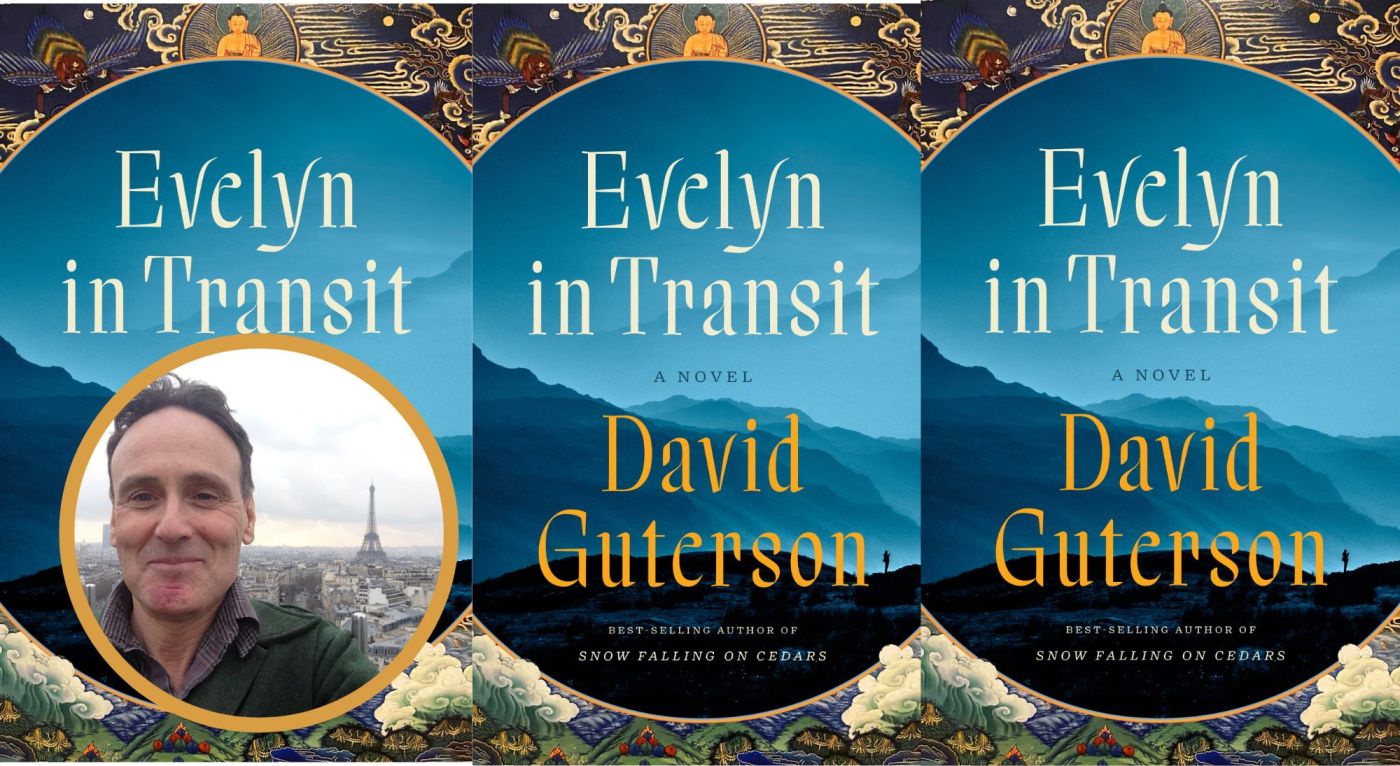
That particular job is not accidental in David Guterson’s latest novel, “Evelyn in Transit.” The book occasionally leaves Evelyn’s rambles to follow a young Tibetan boy named Tsering, who goes on to become an important lama. The lama eventually lands in America and briefly crosses paths with Evelyn. It’s a small moment, but a life-changing one, leading to a moment when Evelyn, a single mother, is told that her young son is the lama reincarnated.
Guterson is best known for “Snow Falling on Cedars,” but he likes taking chances with his novels – his last, “The Final Case,” blended fact and fiction with a light touch. This time around, he is taking us on Evelyn’s (and Tsering’s) journeys, exploring the ideas of finding meaning in religion and in the world around us, without a heavy emphasis on plot or traditional structure.
: Like books? Get our free Book Pages newsletter about bestsellers, authors and more
“There are certain ways in which this book is a departure for me, and it’s stylistically different, but there’s a throughline in all my fiction in terms of my world view and the idea that the characters demand of life that it be lived meaningfully,” Guterson said in a recent video conversation.
This interview has been edited for length and clarity.
Q. Where did this book come from?
There was a Tibetan family that fled as part of the diaspora in the late ’50s and early ’60s, and I became fast friends with one of the sons. He had a great-uncle and a great-aunt who were both monastics in robes, and the great-uncle was, I think, the third in his line of reincarnated prominent lamas.
I’ve had in mind for my entire adult life finding some way to shape and construct a story that would allow me to explore these ideas. But every time I contemplated it, I thought, “There’s something potentially off-putting about a book that takes up these things. A lot of people, when they hear about Buddhism, they roll their eyes and think it’s just new-agey stuff, something people in Hollywood do.
Still, this material is full of peril for a storyteller. So I felt some trepidation about going there unless I was able to tell us the right kind of story.
Q. So what made you take the plunge?
I really tried to bring to bear the idea that Tibetan Buddhism has a rigorous logic. It’s more like Western philosophy than it is like a belief system. People say, Well, if you believe in the Buddha or reincarnation, then it’s a belief system. But it’s more an investigation into the nature of reality, the nature of the self, the nature of the mind. I tried to present it that way in the novel, to fend off the notion that these are woo-woo ideas.
I was very interested in someone who’s grappling in a serious way with sort of the existential human questions of meaning and purpose and value and how to live, how to confront the challenge of being human. I was looking for a story that allows an exploration of that. So thematically,