Today February 4, 2026, 05:11 AM
Today February 4, 2026, 05:11 AM
Some boondoggles are just too good to quit, apparently.
On Tuesday’s gubernatorial debate hosted by Fox 11 and KTVU FOX 2, the candidates in attendance were asked their rapid fire thoughts on the high-speed rail project. Helpfully, they were given the options, “Complete it,” “Shrink it” or “End it.”
Half of the candidates didn’t understand the concept of a rapid fire question. In any case, all of the Democrats who attended were on board with continuing to set money on fire to keep the project going.
Former Congressman and California Attorney General Xavier Becerra kicked things off: “Japan has it. Europe has it. China has it. We’re going to have it too. We’re just going to do it smart. We’re not going to have these cost overruns. And we’re going to make sure it runs efficiently because Californians need to have access to high-speed rail.”
San Jose Mayor Matt Mahan responded, “We need to complete it with a different mindset and greater accountability for getting it done.”
Billionaire Tom Steyer responded, “Who isn’t for high-speed public transportation? But we can’t pay any price for it.” And after some crosstalk with a moderator trying to prevent him from going on, said, “Complete it.”
To their credit for getting how rapid fire questions work, state Superintendent of Public Instruction Tony Thurmond, former Los Angeles Mayor Antonio Villaraigosa and former state Controller Betty Yee all answered, simply, “Complete it.”
Republican Steve Hilton, the only member of his party on the stage, likewise ran through the rapid fire format, “They’re not even talking about completing it for another decade or so. No of course not. We can’t send good after bad. We have to invest that money in real things that help families,” like expanding roads and local rail services.
Hilton at least got it right.
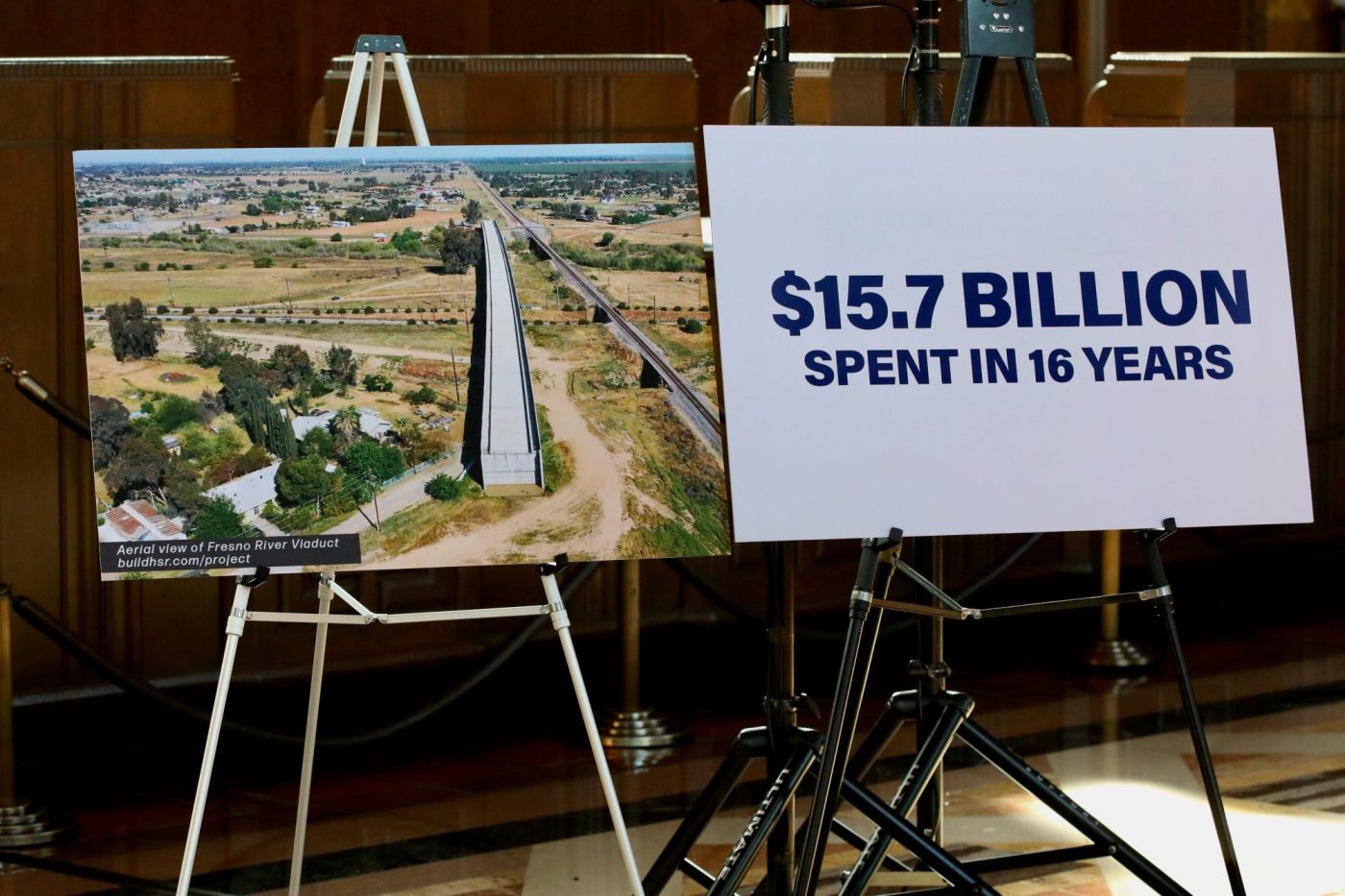
A brief history lesson. Californians approved bond-funding for the high-speed rail project with Proposition 1A in 2008 amid promises a high-speed rail line connecting Los Angeles and San Francisco would be up-and-running by 2020 for as little as $30-something billion in costs. It’s 2026, the project has more than tripled in estimated costs and we might be lucky to ride the segment from Bakersfield to Merced in the early 2030s.
Becerra’s vow that “We’re just going to do it smart” and “We’re not going to have these cost overruns” is nearly two decades late. Likewise, Mahan seems to think throwing around the words “mindset” and “accountability” will turn an expensive testament to government failure into a winner. That’s obviously not the case.
Among the Democrats not on the stage are Rep. Eric Swalwell and former Rep. Katie Porter, both of whom pushed for federal funding of the project in the past.
Of all the Democrats, it is Porter who once had the sense to rip into the project.
“Increasingly, the evidence is showing that this project is not going to be able to be completed remotely on budget or remotely on time. I think we’re already past those benchmarks,” Porter told Inside California Politics host Nikki Laurenzo in May 2025. “That’s why I don’t think we should BS California voters. They have noticed that we don’t have a high-speed rail. And they have noticed we’ve spent money on it.”
She continued, “If this high-speed rail project can get done, then let’s get it done. If it can’t get done, then stop.”
Then, a week later, she backtracked while at an event trying to get union votes, telling a Politico reporter she wants to “put people to work, and I want to get it done for Californians.”
In other words, unless Eric Swalwell has a bullet train hot take no one expects, the Democratic field is unanimously pro-boondoggle. That bodes poorly for anyone hoping for some evidence that California Democrats are capable of recognizing failure when they see it.