Today January 28, 2026, 03:45 PM
Today January 28, 2026, 03:45 PM
When the jazz trumpeter and composer Terence Blanchard invited his friend, the musician-producer Don Was, to headline a night at a jazz series Blanchard was curating for the Detroit Symphony in 2024, Was said yes – even though he didn’t actually have a band or any songs at the time.
“Then I had to think about what to do,” says Was, who in the ’80s recorded and toured with the eclectic rock-jazz band Was (Not Was) before shifting his focus to producing. “And I flashed back to the early ’90s when I was just getting started as a producer.
“I got on a roll with a lot of my heroes in very short order,” he says during a recent phone call. “Bob Dylan, Brian Wilson, Keith Richards, Willie Nelson, Kris Kristofferson, Leonard Cohen. The great writers of our time, I think.
“And one of the byproducts of that was it gave me a severe case of writer’s block for about five years,” Was says. “Every time I sat down at a piano it started up. I just though, ‘What is the point of this when Brian Wilson lives a mile away. Let’s just give him the lyrics.’”
Then one day, while in a recording studio with Willie Nelson, an epiphany arrived.
“I was again lamenting the fact that I can never be Willie Nelson, and then the converse struck me,” Was says. “But Willie Nelson can never be you.
“He didn’t drop acid and go see the MC5 at the Grande Ballroom,” he says of his early life as a native of Detroit, where he was born in 1952. “And George Clinton didn’t play a sock hop at his junior high school. He didn’t go see the Motown Revue as a 12-year-old when they played for 200 people at a Saturday matinee.”
Was thought about the old music business adage “that says if you’re different from whatever was fashionable, you’re a marketing problem,” but decided to flip that on its head.
“It struck me that no, actually the thing that makes you different is your superpower as an artist,” Was says. “Everyone should cultivate that. I tried to impart that to artists I was producing or artists on Blue Note [Records, the iconic jazz label he’s been president of since 2011.]
“So I decided to just take my own advice and if I had to put a band together, be yourself,” he says. “I’m going to go back to Detroit, play with musicians who grew up listening to the same radio stations, played the same bars, played with the same musicians, for the same audiences, and find some people who spoke the common musical languages of Detroit.
“So that’s what I did.”
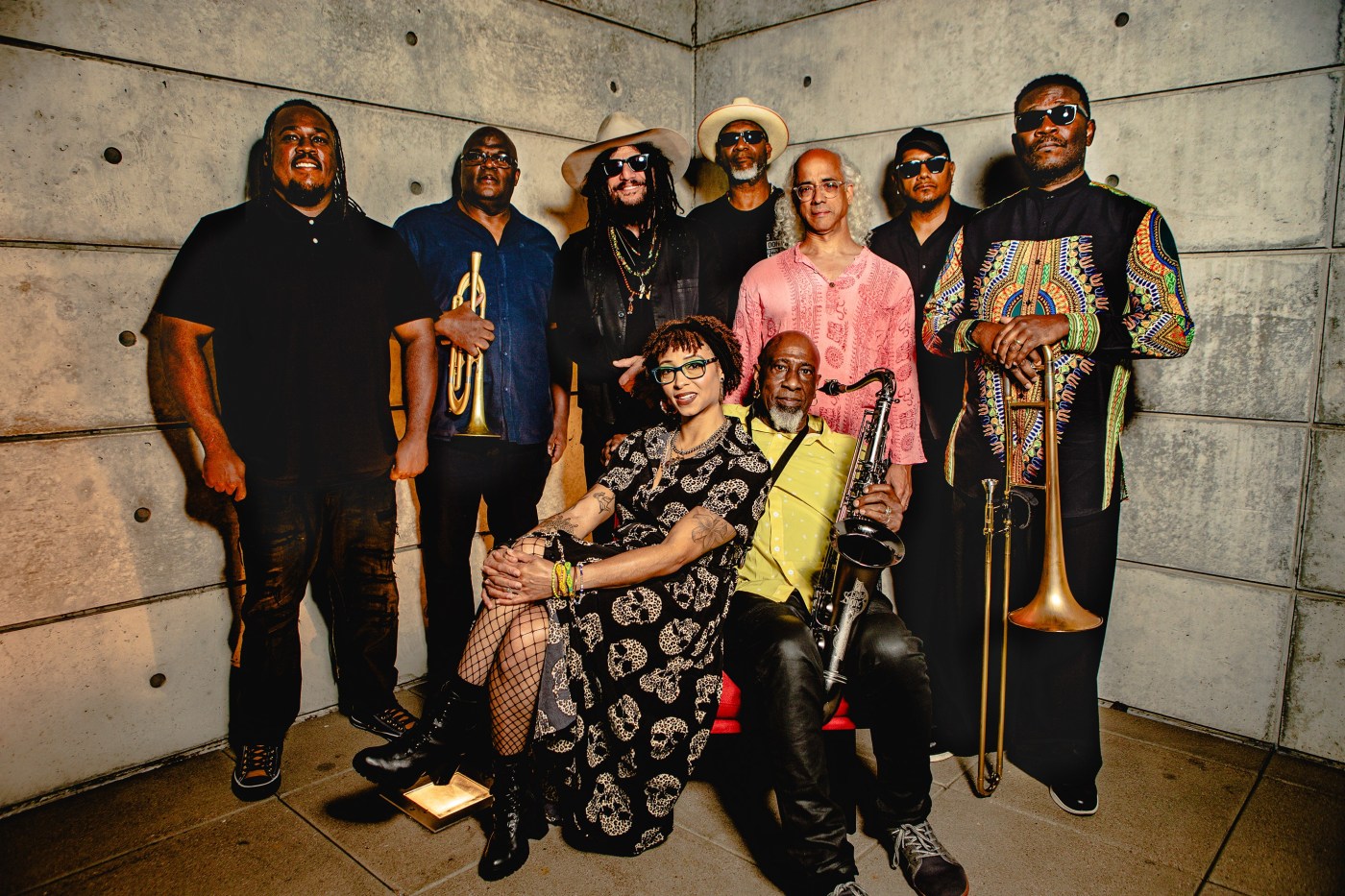
The eight musicians he gathered included some he’d played with for 45 years, such as saxophonist Dave McMurray and keyboardist Luis Resto, who’d worked in Was (Not Was). Trombonist Vincent Chandler, trumpeter John Douglas, drummer Jeff Canady, percussionist Mahindi, guitarist Wayne Gerard, and vocalist Steffanie Christi’an fill out the group.
The familiarity was instantaneous.
“We got together one day, and in the first 10 minutes it sounded like we’ve been playing together for a decade,” he says. “There was this commonality of experience and roots.”
Don Was and the Pan-Detroit Ensemble played the jazz show that Blanchard had booked for them. And then, they kept playing shows. The group released the album “Groove in the Face of Adversity” in 2024, and is coming to Soka University in Aliso Viejo on Sunday, Feb. 1, for its first Southern California show.
In an interview edited for length and clarity, Was talked about his musical roots in Detroit, how the ensemble embodies the city’s disparate musical roots, why the group decided to play a 50-year-old Grateful Dead album in full at their shows, and more.
Q: So were George Clinton and Parliament still wearing suits, not the wild Funkadelic clothes, at your junior high?
A: No, that was the thing. They were still a five-piece vocal band called the Parliaments, but they showed up dressed like hippies. And they weren’t taking cues from [Jimi] Hendrix. It was synchronous. There was just something in the zeitgeist for R&B groups to start learning from some of the rock and roll ethos. And it blew everybody’s mind.
“They came and lip-synched “(I Wanna) Testify.’ Back in those days, it was a form of payola. A local disc jockey would get a gig paying 200 bucks to emcee a school dance, and if you wanted him to play your song, you’d show up for free and plug your single, and then he’d play your song. That’s what George was doing.
The weird thing is that it was at Clinton Junior High School.” [He laughs] But you were going to ask about the essence of Detroit music?
Q: Yeah, I don’t know if it’s more varied than any other city, but it goes from blues and jazz to Motown, which was groundbreaking, to MC5, the Stooges, all the way to the White Stripes. So what makes Detroit music?
A: You grew up in this jambalaya of musical styles and learned to respect them, and become aware that there are other ways of playing something. And you ended up incorporating that into what you did, I think. It was an openness to ignoring the boundaries of genre, which are really only useful if you’re organizing a record store. It’s not how musicians actually play and operate.
So there’s that, but then there’s also the fact that it’s a one-industry town and it’s a working-class town. Everybody’s fate is tied to the success or failure of the auto business, or was certainly back then. It creates a more honest, no [bleep] population.
That kind of raw honesty permeates the music. I say John Lee Hooker has been the [prime] exponent of Detroit music because it’s so raw. You almost think it’s going to fall apart, but it never does. In fact, it grooves like crazy. It’s got a deep groove, and he’s just for real. It’s honest and raw.
And that’s what the people are like. If you really follow all the different streams of music that came out, whether, as you pointed out, it’s Mitch Ryder and MC5 and the Stooges and the White Stripes, or in R&B, Fortune Records and Motown and J Dilla. And jazz, Elvin Jones and Joe Henderson. They all had that raw honesty to what they were doing.
Q: On “Groove in the Face of Adversity,” there’s one song you wrote and then covers of songs by Curtis Mayfield, Hank Williams, Kenny Barron, and a New Zealand band, Fat Freddy’s Drop. How do they all become Detroit music when you play them?
A: There’s a type of groove we play. I don’t know really how to describe it, but you can recognize it when you hear it. The proof is in – like, in the middle of the set we’re playing the Grateful Dead album “Blues for Allah” in its entirety.
[The late Grateful Dead guitarist-singer Bobby Weir formed the Wolf Brothers with Was and drummer Jay Lane in 2018. We spoke with Was three days before Weir’s death on Jan. 10, 2026.]
It’s sandwiched between our own songs, and if you didn’t know the Grateful Dead or our own repertoire, I don’t think you’d know when we started playing “Blues for Allah” in the show. If we told you they were all originals, you’d probably believe it, because we try to approach it not to do karaoke versions of the songs, but how does this band play them?
Are you a Deadhead? There’s a song on “Blues for Allah” called “King Solomon’s Marbles.” To be honest, I always thought it was just an improvised jam in a crazy time signature. Only when I got into it, I realized there’s a real structure underneath it that triggered the way we should approach it.
It’s that at the beginning they kind of quote “Inner City Blues,” Marvin Gaye. [He sings a bit of that song’s signature riff.] That riff starts out the song on “Blues for Allah,” so all right, there’s something we can relate to [as Detroit musicians]. So we put a groove like “Inner City Blues” underneath the whole song, but we play the song correctly and stretch out on it.
We found a way to play that song and be ourselves, which I think is the goal for every musician.
Q: Has Bobby seen the group play “Blues for Allah” or heard it? Or any of the other guys from the Dead?
A: They know we’re doing it. I wanted to wait until I had a really good recording. I know he’s seen like YouTube audience stuff. He’s been super positive about it.
Q: Let me ask about the one original song, “You Asked, I Came.”
A: That comes from a movie score that I did in the ’90s for a movie called “Backbeat,” which is about the Beatles in Hamburg before they became famous. [Was won a BAFTA for that score in 1994.] It was kind of a cool film because we put a band together to play the tracks for the actors to be the Beatles.
It was Dave Grohl [of Foo Fighters] and Dave Pirner [of Soul Asylum]. Thurston Moore from Sonic Youth, and Mike Mills [from REM] played bass. We just got together and jammed out these Beatles’ covers that they used to play in Hamburg. And they wanted a jazz score to contrast it because they were on the fringe of the Hamburg beatnik scene.
So that was a song from the score, and we’d never been able to play it, so it’s nice to be able to pull it out and do it for the first time. But we just picked cool songs that they felt like playing. Kind of trying to figure out what the band was, who are we, and how far can we stretch?
Q: As far as the title, “Groove in the Face of Adversity,” I read that it goes back to a moment you had as a kid with your mom and a Joe Henderson song on the radio?
A: You’re correct in referring to that incident. I was driving around with my mom on a Saturday. She’s making me run errands with her when I wanted to be with my friends, and I was being a real [bleep] as 14-year-olds are going to be.
She just left me in the car with the keys and said, ‘Play the radio.’ So I landed on a Detroit jazz station that I didn’t even know existed at that time. And that came right at the top of the solo, where you can hear it. He goes [Was sings a bit of Henderson’s solo on “Mode for Joe”] and the sound of that horn, I’d never heard anyone evoke that feeling with the saxophone before.
I was startled because it matched the angst I was feeling, being stuck driving around with my mom. But then [drummer] Joe Chambers kicks in, and in about 20 seconds Joe [Henderson] falls into the pocket and he’s grooving.
And I thought he was speaking to me. I thought the message was you’ve got to groove in the face of adversity, Don, you know, be nicer to your mom, and be good company. And it worked. In about three minutes, my mood changed 180 degrees, and I realized, Whoa, this music had the power to do that? And there weren’t even lyrics on it?
I found groove in the face of adversity to be such a succinct message, something that really helps. Like any time you’re facing some kind of wall, grooving through it is an effective way of dealing with it. Never losing your cool or your poise, but staying firm in your goals and your direction.
Q: That’s a great story. Something we can all probably use.
A: In crazy times like these, I think it’s maybe more relevant than it ever was. I don’t care what end of the political spectrum you find yourself on, it’s equally relevant to everybody.
These are stressful, chaotic, confusing times, and the best way through it is to find human connection. You can groove this country back together.
Q: Wouldn’t that be nice?
A: If you have doubts about it, you can go to a Willie Nelson show and see it in action. You get one of everything at his shows. There’s never a fight in the audience, and there’s nothing polarized at a Willie Nelson show. Everyone is experiencing a kind of collective joy.
Same thing at a Grateful Dead show, really. I’ve seen former Black Panthers at Grateful Dead shows, and I’ve seen Ann Coulter at a Grateful Dead show.
Q: I would not have guessed she was a fan –
A: – Oh yeah. Yeah, I mean, Donald Trump went to a Grateful Dead show once. I think he introduced him at one. I don’t remember if it was Grateful Dead or Weir and RatDog. [It was a RatDog show in 2006.]
But that’s the point of music. Certainly, the point of our show was this. We want people to feel like they’re part of the fabric of humanity and that we’re all connected.
It’s something I really learned with Bobby [Weir]. It’s that the audience is so tuned into the thing that if you let them become part of the band, and you feel their reaction, and you let that impact the choice of the next notes that you play, you get this kind of collective ecstasy, is what it is, and it would blow the roof off the place.
It’s why, at 73 years old, it’s all I want to do [is make music with the Pan-Detroit Ensemble]. I’m happy to just go on and play it and experience that for the rest of my life, man. I don’t know anything better than that.